
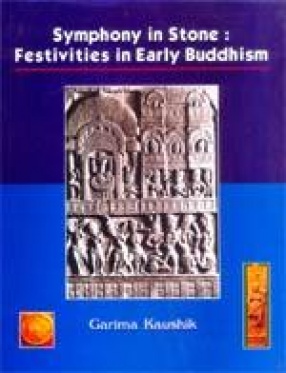
Symphony in Stone: Festivities in Early Buddhism
Synopsis
Early Buddhism i.e. the Theravada doctrine, as we know it today is considered synonymous with renunciation, austerity and a very severe monastic code, which strictly forbade through its canons any kinds of festivities. Contrary to popularly projected view and accepted beliefs, one does find in the sculptured delineations associated with early Buddhist architecture and contemporaneous Buddhist literature. Evidence and references, albeit marginal, to dance and musical instruments. The aim of this study is to bring out the underlying contradiction between canonical precepts and actual practices as is evident from sculptural representations: and to study the various contexts in which dance and music existed in Theravada Buddhism. This study attempts to document and classify the existing references through archaeological (painting and sculptures), literary (primarily non-canonical texts, like the biographies of the Buddha, The Jatakas, travelogues of the Chinese travelers etc.) and epigraphic evidences and to sort them according to the rules of conduct for the monastic as well as the lay mode of living. A Cursory study of the sculptural and literary evidences representing dance and music have been classified, based on the themes they represent into three categories, which form the basis of the three chapters of this book. These are : Chapter 1. Festivities and Ceremonials : It discusses under its head three categories of representations. They are all secular scenes which include:1)Musicians and / or dancers accompanying royal processions. 2) Court scenes, which also include the Hare scenes. 3) Depictions of the Buddha's previous lives (Jatakas), in association with dance and music e.g. The Mahakapi Jataka, where musicians and archers are engaged in a fight with monkeys. Chapter 2. Evolution of the Buddha Legend In this chapter, the gradual incorporation of dance and music within and as a part of the biographical narrative of the Buddha has been discussed. It discusses how this incorporation was undertaken over a long period while also discussing the assimilation and significance of mythical creatures within the narratives of Buddhas live's. Chapter3. Worship of the Buddha. It discusses the worship of the Buddha in accompaniment with dance and music. It gives a detailed description of all the festivals in which music and dance figured prominently. These Chapter are an attempt to study the gradual incorporation and evolution of festivities ( that include dance and music) within Early (Theravada) Buddhism.
Read more
96.30
86.67
$
107.00 $
Free delivery Wolrdwidе in 10-18 days
Ships in 2-4 days from New Delhi
Membership for 1 Year $35.00
Get it now and save 10%
Get it now and save 10%
BECOME A MEMBER

Bibliographic information