
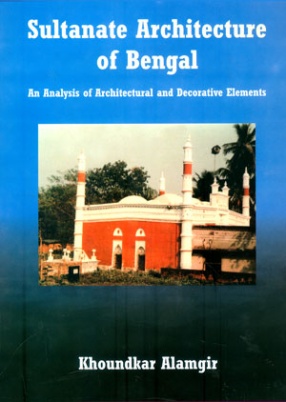
Sultanate Architecture of Bengal: Analysis of Architectural and Decorative Elements
Various indigenous and extraneous elements of Sultanate Architecture of Bengal have been discussed in this book. How these elements are manifest in different monuments of Bengal has also been shown. The idea of mosques and tombs is itself extraneous. Muslim immigrants brought with them many characteristics and traits of architecture from their country of origin. On the other hand many local elements also crept into the joint endeavour of the conquered and conqueror, who created an architecture of a cosmopolitan character. While visiting monuments of this period one can visualise elements from Iran, Central Asia, Egypt and even from Europe vis-a-vis tahtched roofs of rural huts and elements of previous Buddhist and Hindu architectural elements originating from Bengal.
Some elements may be classified as indigenous or extraneous without any doubt. But some of these elements give scope for controversy. Elements like glazed tiles and actuate system of buildings etc. are no doubt extraneous elements. On the other hand curved cornices and hut-shaped roofs of buildings etc. are of indigenous origin. Some elements are controversial, such as, small covered type mosques, profuse use of terracotta’s, trefoil arched mihrab in the Adina mosque etc.
All the monuments describe in this book have been visited by the author starting from 1979 A.D. Main aim and objective of this book is to trace the origin of diifferent elements of Sultanate architecture of Bengal. This book contains six chapters i.e. Sultanate Architecture of Bengal, Different Sultanate Buildings of Bangladesh, Miscellaneous Buildings, Different Elements of Sultanate Architecture of Bengal, Decoration in Sultanate Buildings and Major Findings. These chapters are supported with illustrations, notes, references, bibliography, glossary, colour photographs and will be interest to the scholars, students as well as to the general readers.
Get it now and save 10%
BECOME A MEMBER
Bibliographic information